

Quick Summary
A durable dog harness for daily walks needs reinforced stitching at the chest and D-ring junctions, solid metal hardware, and wide adjustable straps that fit without restricting the stride. Daily load wears harnesses down at the seams, so inspect them regularly. Measure your dog's chest before buying.
- Daily walks add repeated stress, so the stitching and hardware at the chest and D-ring matter most.
- Look for box-X or bar-tack stitching and two parallel rows at stress points.
- Metal D-rings and buckles outlast plastic, and the anchor method matters as much as the metal.
- Measure your dog's chest circumference at its widest point, just behind the front legs.
- Flex the D-ring anchor and check for fraying every few weeks, and replace the harness when wear shows.
Table of Contents
- Why Daily Walks Wear Out a Harness Faster Than You Think
- How We Evaluated Durability: Stitching, Hardware and Straps
- Quick Comparison: Noble Paw's Daily-Walk Harnesses
- Best Dog Harness No-Pull Options for Strong Pullers
- Large Durable Dog Harness for Daily Walks: Sizing and Weight Limits
- Best Dog Harness for Comfort: Padding, Chafing and Breathability
- Best Dog Harness for Walking: Matching a Harness to Your Routine
- Common Harness Mistakes That Shorten Its Life
- Choosing Your Daily-Walk Harness and Next Steps
- Frequently Asked Questions
Last Updated: November 5, 2026
Daily walks test a dog harness in ways that a single outing never does. Every pull, sudden lunge at a squirrel, and stop at the curb puts stress on the stitching, the buckles and the chest plate. Noble Paw Outfitters built this guide to help you pick a durable dog harness for daily walks, so the one you buy in January still holds up in the fall. Fit and movement matter as much as strength when you choose a harness, since any harness that restricts the stride can change how a dog walks.
Here is what the rest of this guide covers: how daily wear breaks harnesses down, the criteria we used to judge stitching, hardware and straps, and how each harness in our lineup suits a different dog and routine. We also cover sizing for larger breeds and the common mistakes that shorten a harness's life. A durable dog harness for daily walks should stay secure, stay comfortable and stay intact over time.
Why Daily Walks Wear Out a Harness Faster Than You Think
A harness on a daily walk takes repeated load, not one hard event. Each walk adds small stresses at the stitch lines, the webbing and the buckle. Over months, those stresses add up, which is why a harness can look fine and still fail at the seams.
The most common failure points are the chest strap junctions, where the webbing bends under pull, and the D-ring anchor, where force concentrates. Sand, rain and salt speed up the wear. A harness that only sees weekend hikes will age more slowly than one clipped on every morning and evening.
Watch for fraying at the stitch lines, a stiffening or cracking strap, and a buckle that no longer clicks firmly. Any of these means the harness has reached the end of its safe working life.
How We Evaluated Durability: Stitching, Hardware and Straps
Reinforced stitching and metal hardware are good starting points, but they do not fully show how a harness will hold up to a year of daily walks. The criteria below can help you check any harness in a store or at home.
1. Stitch pattern and density at stress points. Look at the chest-strap junction and the D-ring anchor, where load concentrates. A single line of lockstitch is the baseline; box-X stitching or a bar-tack across the junction spreads force over more thread and is the pattern most likely to survive repeated lunging. Count the rows: two parallel rows at a junction resist unraveling far better than one, because a broken thread in one row does not open the seam.
2. Hardware material and attachment method. Metal D-rings and buckles outlast plastic, but the anchor matters as much as the metal. A D-ring sewn through a thin webbing loop concentrates force on a few stitches; a D-ring captured by a reinforced webbing channel or a metal slider distributes it. Check that buckles click firmly and release with a deliberate squeeze rather than a tug.
3. Webbing width and stretch. Wider straps spread load across the chest and resist the elongation that lets a harness loosen over months. Narrow webbing on a strong dog concentrates pressure and stretches at the adjustment points, which is where fit retention fails first.
4. Adjustment-point retention. Sliders and tri-glides should hold their position under load. A harness that needs re-adjusting after every walk is telling you the hardware is slipping, and a slipping strap rubs and wears at the same spot.
5. Long-term wear indicators. Rather than rely on a general durability claim, inspect for the specific signs that daily use leaves: fraying at stitch lines, webbing that stiffens or cracks, reflective trim that peels, and buckles that no longer click. Any of these means the harness has reached the end of its safe working life, regardless of how new it looks.
We also weighed comfort and fit, because a harness that rubs or slides wears faster at the contact points as well as irritating the dog. Durability and comfort are linked: a well-fitting harness puts less strain on any single point, and a harness that stays put does not saw at its own stitching.
Watch out: a harness can pass a visual check and still be compromised at the D-ring anchor, so flex the anchor and tug the ring gently before every few weeks of use rather than trusting appearance alone.
Quick Comparison: Noble Paw's Daily-Walk Harnesses
The table below summarizes how our daily-walk harnesses compare on price and the use cases they suit best.
| Harness | Starting Price | Best For |
|---|---|---|
| Tactical Dog Harness - Heavy Duty & Quick Release | $54.95 | Medium to large dogs, rugged outdoor use |
| Easy On, No-Pull Dog Harness | $35.00 | Strong pullers, busy public spaces |
| No-Pull Safety & Service Dog Harness | $39.95 | Working dogs, high-traffic areas |
| Touchdog 'Avery Patterned' Tough Stitched Harness and Leash | $19.99 | Small to large dogs, budget-conscious buyers |
| 'Bark-Mudder' 2-in-1 Reflective Sporty Harness and Leash | $42.99 | Active dogs, low-light walks |
Tactical Dog Harness - Heavy Duty & Quick Release. This harness is built for medium to large dogs and daily walks. It uses heavy-duty, breathable fabric, reinforced stitching and metal quick-release buckles. Two metal D-rings allow front or back leash attachment, and a top handle helps with control in crowded spaces. See the Tactical Dog Harness Heavy Duty Quick Release for its full construction details. Best for: active dogs and owners who want rugged construction. Skip if: your dog is small and the heavier build feels like overkill.

Easy On, No-Pull Dog Harness. The chest-supported design reduces pulling strain, and the fully adjustable straps fit a range of body shapes. Reflective stitching helps during early-morning and evening walks. Best for: owners of strong pullers. Skip if: you want a harness that goes on without any fitting adjustment. Compare the Yeehaw Harness from The Modern Dog Company as another daily-walk option.
No-Pull Safety & Service Dog Harness. Built for working dogs, it includes a stainless-steel D-ring and a reinforced top handle. It comes with two service dog patches. Best for: working dogs and high-traffic routines. Skip if: you only need a basic everyday harness.
Touchdog 'Avery Patterned' Tough Stitched Harness and Leash. The dual-reinforced stitching and stainless steel leash connector make this a strong value option. Sizing runs by chest circumference, with three sizes listed. Best for: budget-conscious owners of small to large dogs. Skip if: your dog is over the listed weight range for its size.
'Bark-Mudder' 2-in-1 Reflective Sporty Harness and Leash. Made from 600D Oxford nylon and polyester, with reflective lining and double-adjustable straps, it suits active dogs. The leash has swivel connectors that reduce tangling. Best for: active dogs and low-light walks. Skip if: you prefer a fully padded harness for sensitive skin.
Best Dog Harness No-Pull Options for Strong Pullers
Pulling is the main reason a harness takes abuse on daily walks. A no-pull design moves the leash attachment to the chest, which redirects a lunging dog instead of letting it lean into the strap. That reduces strain on the harness and on your shoulder.
The Easy On, No-Pull Dog Harness and the No-Pull Safety & Service Dog Harness both use a chest-supported structure. You can view the Easy On No Pull Dog Harness directly to check its strap layout. Each has adjustable chest and belly straps and a D-ring. For a strong puller, check that the front attachment point sits centered on the chest and that the strap does not ride up toward the neck.
Tactical Dog Harness - Heavy Duty & Quick Release →

A harness alone rarely fixes pulling. Pair it with consistent cues and short training sessions. A shorter no-pull leash can serve as a companion to a harness for tighter control.

Large Durable Dog Harness for Daily Walks: Sizing and Weight Limits
Large dogs put the most load on a harness, so sizing and weight limits matter. Measure your dog's chest circumference at its widest point, just behind the front legs, and compare it against the size chart for the specific product. Do not rely on breed or weight alone, because body shape varies widely.
The Tactical Dog Harness is built for medium to large breeds. For the Touchdog harness, check the chest circumference and weight ranges on its size chart, and do the same for the Bark-Mudder harness.
Check the fit by sliding two fingers under each strap. The harness should sit snugly without restricting the shoulders or stride. Recheck the fit every few months, because a growing puppy or a dog that gains weight will outgrow it.
Best Dog Harness for Comfort: Padding, Chafing and Breathability
Comfort is not a softness contest. On a daily walk, discomfort comes from pressure concentrated in the wrong place, from straps that restrict the shoulder, and from moisture trapped against the skin, and each of those also accelerates wear. A harness that chafes encourages the dog to chew or scratch at it, and a rubbing strap wears faster at the contact points.
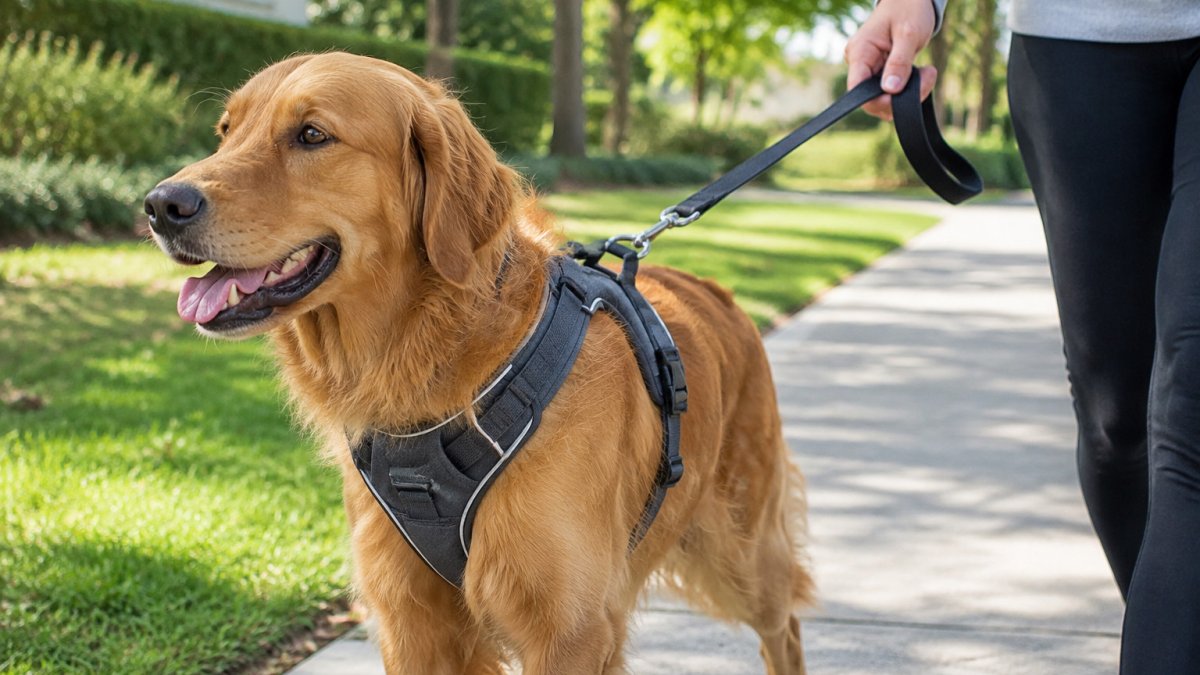
Pressure distribution. Load should spread across the chest plate and the broad flat of the sternum, not sit on a narrow strap edge. A padded panel under the chest and a wide belly strap spread force; a thin strap concentrates it. On a strong puller, the difference shows up as a red line or a rubbed patch after a long walk.
Shoulder mobility. The front of the harness should sit behind the shoulder blade, not across the point of the shoulder. A strap that crosses the shoulder restricts the stride and rubs with every step. Watch the dog walk: a shortened front stride or an odd hitch often means the front strap is too far forward.
Rubbing points to check. The armpit, the point of the shoulder, the sternum, and the top of the back under the handle are the four places daily-walk chafing shows up first. Run a finger under each strap; if it pinches, the fit is wrong, not the padding.
Breathability and moisture. A padded mesh lining that breathes matters most in warm weather and on long walks. Harnesses with a neoprene exterior and a breathable mesh interior, like the Wolfdoge Signature Harness, the Great Wave Harness, the Urokomon Harness and the Asanoha Harness, pair padding with airflow. Trapped dirt and moisture cause irritation, so clean the lining regularly and take the harness off at home so the dog is not sitting in a damp strap.
Signs of discomfort during repeated walks. Scratching at the chest, reluctance to have the harness put on, a stiff gait at the start of a walk, or a rubbed patch after a long outing are all fit signals. Address them before they become a habit or a sore.
Check the lining for seams that could rub and make sure the straps lie flat rather than twisting. A twisted strap concentrates pressure on an edge and rubs in exactly one spot.
Watch out: adding a thicker pad to fix rubbing often makes it worse, because extra bulk can push the strap onto the shoulder or trap more heat, correct the fit and strap position first, then adjust padding.
Best Dog Harness for Walking: Matching a Harness to Your Routine
The right harness depends on how you walk. A flat, urban route calls for a light, easy-on design. Trail walks, hiking and wet conditions call for heavier webbing and reflective detail.
The Wolfdoge Signature Harness and the Great Wave Harness are comfortable options for everyday walks. For outdoor and active use, the Tactical Dog Harness and the 'Bark-Mudder' harness hold up well. For low-light walks, prioritize reflective lining, which the Bark-Mudder and Easy On harnesses include.
Consider how many walks you do per day and how long they last. Two long daily walks put more cumulative wear on a harness than one short outing, so favor stitching and hardware over lightweight materials.
Common Harness Mistakes That Shorten Its Life
Several habits wear out harnesses faster than daily use alone. The most common mistake is leaving a harness on a dog for long periods, which traps moisture and dirt against the skin. Take it off at home when the dog is resting.
Another mistake is clipping the leash to the wrong point. A back attachment suits everyday walks, while a front attachment suits pullers. Using the wrong point loads the harness unevenly. Also avoid yanking the leash, which strains the D-ring and stitching.
Finally, do not wash a harness in harsh conditions or dry it in direct heat, since high temperatures weaken nylon and degrade reflective material. Air-dry it and inspect the stitching every few weeks.
Choosing Your Daily-Walk Harness and Next Steps
Start with your dog's size and pulling habits, then choose the construction that fits your daily routine. A durable dog harness for daily walks should combine reinforced stitching, solid hardware and an adjustable fit. Measure your dog before you buy, and recheck the fit regularly.
For rugged daily use, the Tactical Dog Harness - Heavy Duty & Quick Release is a strong starting point. Owners of strong pullers should look at the Easy On, No-Pull Dog Harness. Pick the option that matches your dog's build and your walking conditions, and inspect it regularly so small wear does not become a failure on the street.
Frequently Asked Questions
Which no-pull dog harness is the most durable?
Durability depends mostly on stitching, D-ring hardware and strap material rather than the no-pull feature itself. Among Noble Paw's listings, the Tactical Dog Harness uses heavy-duty breathable fabric with reinforced stitching and metal quick-release buckles, and the No-Pull Safety & Service Dog Harness pairs a stainless-steel D-ring with a reinforced top handle. Check the stitching and buckles before buying, and expect any harness to wear faster on dogs that pull hard every day.
Is it okay for a dog to wear a harness all day?
Harnesses are designed for walks, training and supervised outings, not continuous wear. Remove the harness when your dog is resting or crated, check the skin under the straps for rubbing, and make sure the fit allows two fingers underneath. Lightweight padded options, such as the Wolfdoge Signature Harness with its breathable mesh lining, are more comfortable for longer wear periods.
How should a dog harness fit for daily walks?
A harness should sit snugly without restricting the front legs or shoulders. Measure your dog's chest circumference and compare it to the size chart on the product page, as the Touchdog Avery and Bark-Mudder listings both give chest ranges in inches. Adjust the chest and belly straps so two fingers slide under each strap, then recheck after the first few walks, since straps can loosen with use.
